Every premium cigar you have ever smoked was rolled by a person. Every cheap cigar in a convenience store was rolled by a machine. That distinction is where the conversation usually stops, as though the method of assembly is the only thing that matters. It is not. What matters is what the method of assembly makes possible: different materials, different construction, and a different smoking experience.
This is a guide to what actually separates the two, and what you are paying for when you choose one over the other.
The Tobacco
This is the most important difference, and it has nothing to do with rolling.
Machine-made cigars use homogenised tobacco leaf (HTL), also called reconstituted tobacco. HTL is manufactured by grinding tobacco scraps, stems, and dust into a pulp, mixing it with binding agents, and pressing it into uniform sheets. These sheets are then fed into machines that cut, shape, and wrap the cigars at a rate of several thousand per hour. The filler is also ground tobacco (short filler), not whole leaves.
The result is a consistent product at a low cost. But the flavour ceiling is limited. HTL and short filler do not develop the complex aromatic compounds that whole-leaf tobacco produces during fermentation. The smoke tends to be one-dimensional: an even, mild, slightly papery flavour from start to finish.
Hand-rolled cigars use whole tobacco leaves for every component: wrapper, binder, and filler. The leaves are sorted by priming (the position on the plant), cured, and fermented as individual leaves before being selected by the roller for a specific blend. The filler consists of long leaves folded and bunched to create airflow channels inside the cigar, which is why the draw of a hand-rolled cigar feels different from a machine-made one.
The flavour range is much wider. Whole-leaf tobacco retains its natural oils, sugars, and cell structure through fermentation, which means the cigar develops complexity as it burns: the first third tastes different from the middle, and the middle from the final third.
The Construction
Machine-made: A machine wraps the HTL binder and wrapper around the short filler at a fixed tension and cuts to a fixed length. The consistency is mechanical: every cigar in the box will draw identically, burn identically, and taste identically. This is a feature, not a flaw. If you want a reliable, low-commitment smoke that will always taste the same, machine-made cigars deliver that.
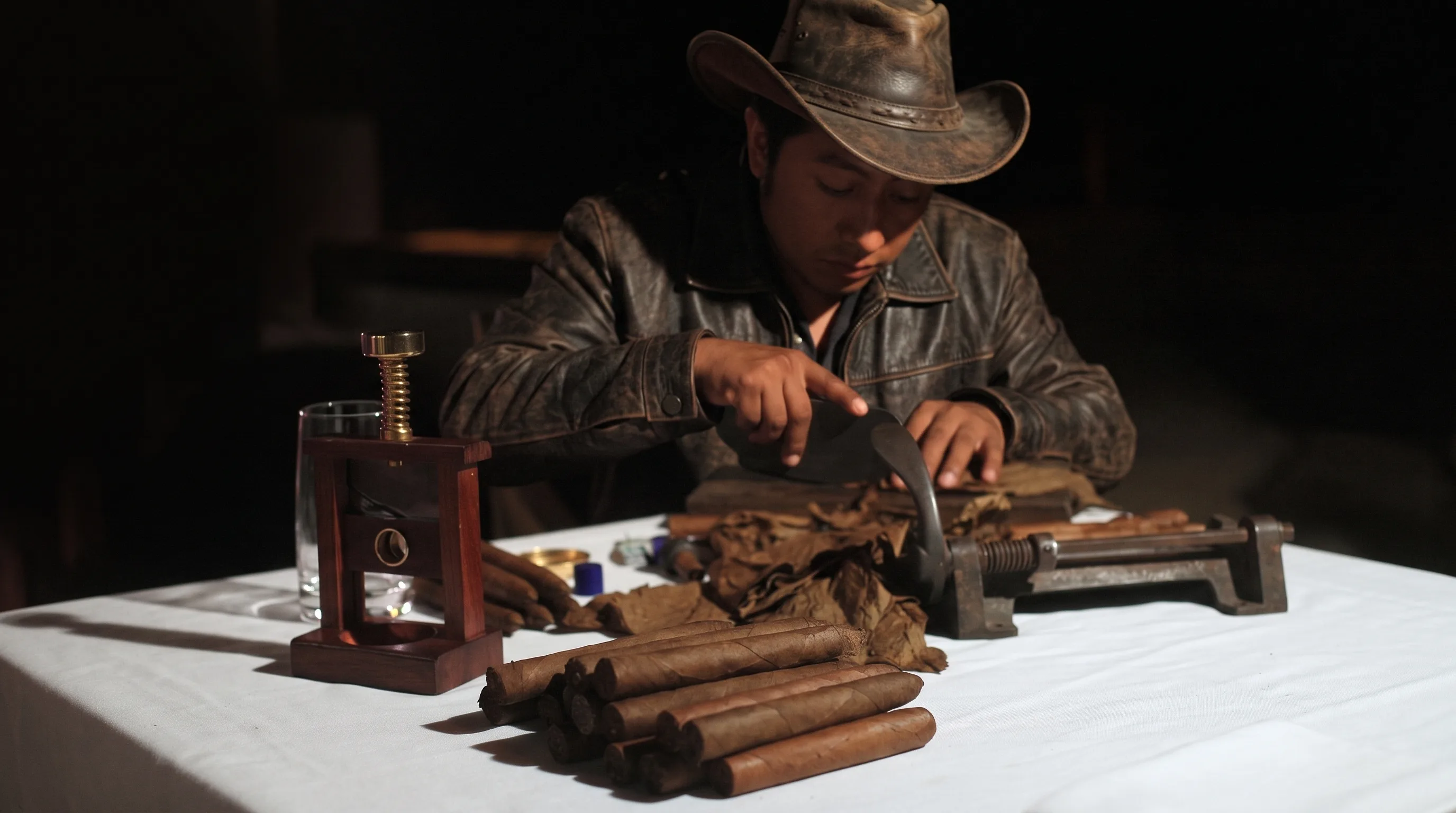
Hand-rolled: A torcedor (roller) assembles the filler leaves by hand, bunches them into the binder, and rolls the wrapper around the outside, adjusting tension and density by feel. The skill required to produce a consistent draw across hundreds of cigars per week takes years to develop. A poorly trained roller produces cigars that are too tight (unsmokeable) or too loose (thin, hot smoke). A master roller, like Don Antonio "Toto" Pucheta at Cházaro's factory, produces cigars with a draw that is consistent from cigar to cigar without being mechanical.
The wrapper application is where hand-rolling is most visibly different. A hand-rolled wrapper has a visible seam that spirals from foot to cap. It is not glued. It is held in place by the natural oils in the leaf and the tension applied by the roller. This requires a wrapper leaf that is thin, elastic, and free of veins or tears, which is why wrapper tobacco is the most expensive component of a premium cigar.
The Burn
Machine-made: Even, predictable, fast. Short filler burns quickly because the tobacco particles are small and uniformly packed. A machine-made cigar of the same dimensions as a premium Robusto will smoke 30% to 40% faster. The ash is typically dark, loose, and flaky.
Hand-rolled: Slower, cooler, and (when well-constructed) even. Long filler burns more slowly because the intact leaf structure retains moisture and oils that moderate the combustion rate. The ash on a well-made hand-rolled cigar is firm, compact, and light grey to white. A long, firm ash is one of the quickest visual indicators of quality construction and proper fermentation.
The Price
Machine-made cigars retail for AED 5 to AED 30 per cigar in the UAE. Hand-rolled premium cigars retail for AED 30 to AED 250, depending on the brand, the origin, the blend, and the format.
The price gap reflects: the cost of whole-leaf (vs ground) tobacco; the cost of multi-year fermentation (vs months); the cost of skilled human labour (vs machine operation); and the much lower production volume of a hand-rolled factory.
Whether that gap represents value depends on what you want from a cigar. If a cigar is a fifteen-minute habit between tasks, a machine-made cigar serves the purpose. If a cigar is a forty-five-minute experience that you sit down and pay attention to, the hand-rolled version delivers something the machine version cannot.
Where Cházaro Sits
Every Cházaro cigar is hand-rolled by a team of twelve at the Real Fábrica de Tabacos in Querétaro, Mexico. The filler, binder, and wrapper are all whole-leaf San Andrés Negro tobacco, fermented for approximately three years before reaching the rolling floor. The production volume is limited by the size of the team and the length of the fermentation cycle, not by machine capacity.
The construction standards are visible in the cigar: firm white ash, an even burn line, a consistent draw, and a smoke time that runs longer than comparable dimensions in most other brands. These are the consequences of long fermentation and skilled rolling, and they are the things that make the price make sense.
Frequently Asked Questions
Are hand-rolled cigars always better than machine-made? Not necessarily "better" in absolute terms, but they offer a wider flavour range, a slower burn, and a more complex smoking experience. Machine-made cigars offer consistency and affordability. The right choice depends on the occasion and the smoker's expectations.
What is homogenised tobacco leaf? HTL is manufactured by grinding tobacco scraps, stems, and dust into a pulp and pressing it into uniform sheets. It is used as binder and wrapper in most machine-made cigars. It burns quickly and has a limited flavour range.
What is long filler vs short filler? Long filler uses whole tobacco leaves that run the full length of the cigar. Short filler uses chopped tobacco pieces. Long filler produces a slower, cooler burn with more flavour complexity.
How can I tell if a cigar is hand-rolled? Look for a visible spiral seam on the wrapper, a closed cap (the rounded tip), and a cigar band from a named manufacturer. Feel the cigar: it should be firm but slightly springy, with no hard or soft spots. Machine-made cigars are typically sold in cellophane sleeves or tins and have a uniform, almost plastic-looking wrapper.
Why are hand-rolled cigars more expensive? The cost reflects whole-leaf tobacco (more expensive than ground), multi-year fermentation (capital-intensive), and skilled human labour (slower production). A factory of twelve rollers cannot produce the volume of a machine running twenty-four hours.