Counterfeit cigars are a global problem dressed up to look like a local one. The cigars themselves usually come from a handful of clandestine operations in Cuba and the Dominican Republic; the wholesalers who move them work across markets; and the cigars end up in Dubai the same way they end up in London, Geneva, or Hong Kong — through tourists buying “bargains” abroad, through grey-market online sellers, and occasionally through low-rent local sources who know their customers won’t check.
The good news is that counterfeit cigars are not difficult to detect once you know what to look for. The bad news is that almost no buyer in the region has been taught how. This guide fixes that. What follows is the seven-test routine that a serious tobacconist runs before stocking a single cigar — simplified so any buyer can run it in under a minute.
What counterfeiters are usually faking
Counterfeit cigars cluster around the marques with the highest brand value and the strongest secondary market: Cohiba (especially Behike), Montecristo No. 2, Romeo y Julieta Short Churchill, Hoyo de Monterrey Epicure, Trinidad Reyes, and Partagas Serie D No. 4. New World cigars are counterfeited less often because the unit price doesn’t justify the operation — you are far less likely to see a fake Padron or Drew Estate than a fake Cohiba Behike 52.
This matters because the test you run depends on what you’re holding. The Habanos seal and warranty hologram apply only to Cuban cigars. The construction tests apply to everything.
The seven-test routine
Test 1: The band
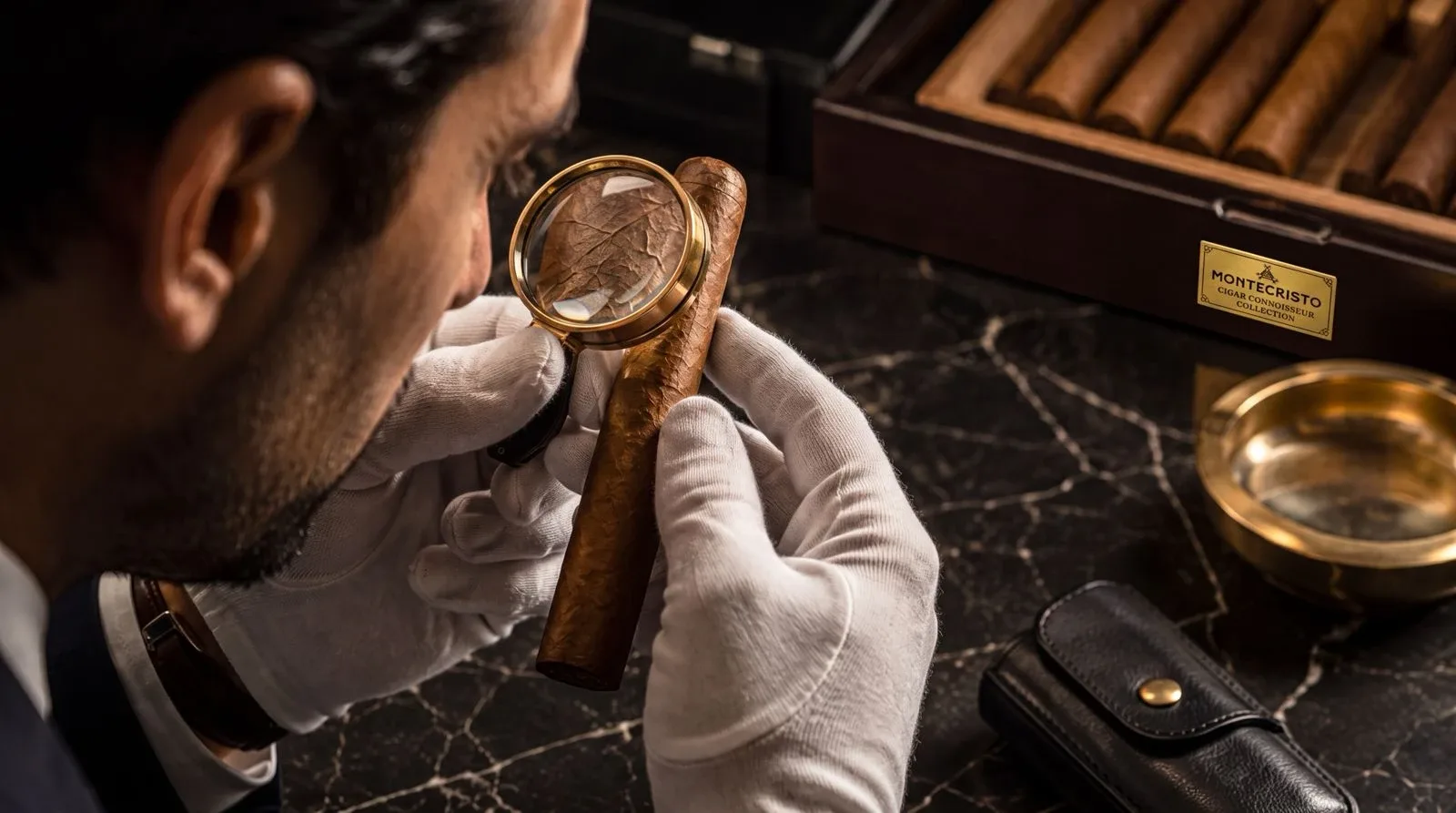
Look closely. A real cigar band has crisp print, perfect colour registration, and embossing or gold leaf where the brand uses it. Counterfeit bands almost always have one tell — slightly fuzzy text, colour that bleeds half a millimetre out of register, or a gold that looks like printed yellow under direct light. Cohiba is the cleanest case: the Cohiba band has dots arranged in a specific pattern (the famous “Cohiba dots”), and on counterfeits the dot spacing is consistently a little off.
Test 2: The cap
Real Cuban cigars are finished with a triple cap — three small leaves wrapped over the head of the cigar. You can usually see the seams if you turn the cigar in the light. Counterfeits often use a single cap (faster to produce) or a sloppy triple cap with visible glue. If the cap looks pasted on rather than rolled, you’re holding a fake.
Test 3: The wrapper
A premium wrapper has the kind of subtle oily sheen that comes from properly fermented tobacco. It feels smooth but slightly toothy under the fingertip, the veins are fine, and the colour is even from the foot to the cap. Counterfeit wrappers tend to be either too dull (under-fermented) or too uniformly dark (dyed). Veins on a fake are often thick and unevenly placed, and the colour can shift visibly within the same cigar.
Test 4: Construction and weight
Roll the cigar gently between your fingers. It should feel firm but slightly springy, with no hard spots and no soft spots. A cigar that crinkles, crackles, or feels hollow has been under-filled or rolled with shredded scrap rather than long-filler leaf. A real premium cigar has a specific density to it — once you’ve held a few, you can feel the difference inside ten seconds.
Test 5: The packaging
Cuban boxes are made of cedar and held together with traditional dovetail joints — you can see the interlocking wood at the corners. The varnish is uniform; the underside is unstamped except for the official codes; the brand-name printing is sharp. The Cuban warranty seal is applied diagonally across the front-left edge of the box and includes a hologram, a barcode, and a four-letter factory code followed by a date in a specific format. On boxes from 2009 onwards, the seal also includes a small printed band that reads “Habanos Unico Garantizado” in microtext.
If the box is plywood rather than cedar, if the dovetails are missing, if the seal is straight rather than diagonal, or if the hologram doesn’t shift colour under tilt — the box and almost certainly the cigars are counterfeit.
Test 6: The codes
Every authentic Cuban box has a factory code and date stamped on the underside. Habanos publishes the current and historical factory codes openly, and online tools — the Cuban Cigar Website maintains the most thorough list — let any buyer verify whether a given four-letter code and date combination is legitimate. The verification takes thirty seconds. If a seller hesitates to let you photograph the underside of the box, walk away.
Test 7: The cold draw
Before you cut and light, give the foot of the cigar a slow inhale. A real premium cigar carries faint, identifiable aromas — leather, hay, cedar, dried fruit, sometimes a touch of cocoa. A counterfeit smells of ammonia, harsh tobacco, or, in the worst cases, of cardboard. Once you know what proper cigar tobacco smells like at the foot, the fakes are obvious.
Where counterfeit cigars typically enter the Dubai market
Most counterfeits in the region do not come from local tobacconists — the authorised dealers in Dubai have too much to lose. The cigars arrive in suitcases.
The four most common sources, in order:
• Tourists who bought “bargain Cubans” from a beach vendor in Havana, Varadero, or Punta Cana — the single largest source of counterfeit Cuban cigars worldwide.
• Online marketplaces and social-media sellers offering Behike 52s and Cohiba Robustos at “insider” prices. If the price is less than 60% of retail, it is not real.
• “Duty-free” bundles purchased from non-official channels at minor airports or border crossings. Genuine duty-free cigars come only from the official La Casa Del Habano and Habanos network.
• Personal “connections” — the friend of a friend who knows a guy. The friend of a friend is, statistically, getting them at the beach in Varadero too.
What to do if you have one
Don’t smoke it. Counterfeit cigars are frequently treated with chemical “flavour” solutions and have been linked to acute reactions in smokers. They are also almost always rolled with scrap and short-filler that combusts unevenly and harshly.
Photograph the cigar, the band, the box, and the codes. If the cigars were sold to you in the UAE by a business claiming to be authorised, report the seller to the brand owner — Habanos S.A. has a formal counterfeit reporting channel, as do Davidoff, Padron, and other premium houses. If the cigars were sold to you abroad, treat the loss as tuition and adjust your buying habits.
How to buy with confidence in Dubai
Three rules.
Buy from an authorised source. La Casa Del Habano on City Walk is the official Habanos franchise in Dubai. The major hotel lounges (Vault, Above 21, Churchill Club, Bulgari) source through authorised channels. Local online retailers — LAAR, Smoke World, Le Cigaro, El Séptimo — are credible mid-market sources.
Buy direct from the brand where the brand sells direct. A growing number of boutique houses bypass the wholesale chain and ship direct to UAE customers through tiered or private-access programmes. Direct purchase removes most of the counterfeit risk by removing every middleman who might have been deceived. Cházaro’s private-access programme works this way.
If the price feels too good, it is. A genuine Cohiba Behike 52 retails in the UAE in the range of AED 1,800–2,200 per stick. A box of 10 sold for AED 4,500 is not a deal; it is a counterfeit.
FAQ
Are Cuban cigars from Dubai duty-free real?
Cigars sold through Dubai Duty Free at the major airports are sourced through authorised Habanos channels and are genuine. Cigars sold from smaller airport kiosks abroad, or from minor border crossings, should be verified before purchase — “duty-free” is not a guarantee of authenticity.
Can you tell a counterfeit cigar by smoking it?
Yes, but the test damages the cigar and possibly the smoker. A counterfeit typically burns unevenly, produces harsh acrid smoke, and tastes of ammonia or cardboard. By that point, you have already lost the money and the evening. Better to run the visual and packaging checks before lighting.
Are Mexican and New World cigars counterfeited too?
Far less often. The unit prices of Mexican, Honduran, Nicaraguan, and Dominican cigars rarely justify the cost of running a counterfeit operation. Counterfeit activity concentrates almost entirely on the highest-value Cuban marques, particularly Cohiba.
What is the Habanos warranty seal and how do I check it?
The Habanos warranty seal is the official authenticity sticker applied diagonally across the front-left edge of every legitimate Cuban cigar box. From 2009 onwards it includes a hologram, a barcode, and microtext reading “Habanos Unico Garantizado”. The hologram should shift colour when tilted, and the barcode should be scannable.
Where is the safest place to buy cigars in Dubai?
La Casa Del Habano on City Walk for Cuban cigars; authorised hotel lounges (Vault, Above 21, Churchill Club, Bulgari) for in-room purchases; established online retailers such as LAAR, Smoke World, Le Cigaro and El Séptimo for delivery; and direct from the brand for boutique houses such as Cházaro that ship to UAE customers through their own programmes.
A closing note
Counterfeit cigars survive on one thing: buyers who don’t know what to look for. The seven-test routine above takes under a minute, costs nothing, and protects you from the loss of an expensive cigar and a worse evening. Run it the next time you’re handed a Behike at a price that sounds too good — and the time after that, on principle, even when the source is impeccable.
To see Cházaro’s current releases, or to learn how the brand ships direct to UAE customers without the counterfeit risk that comes with grey-market resale, visit our collection page or request private access.