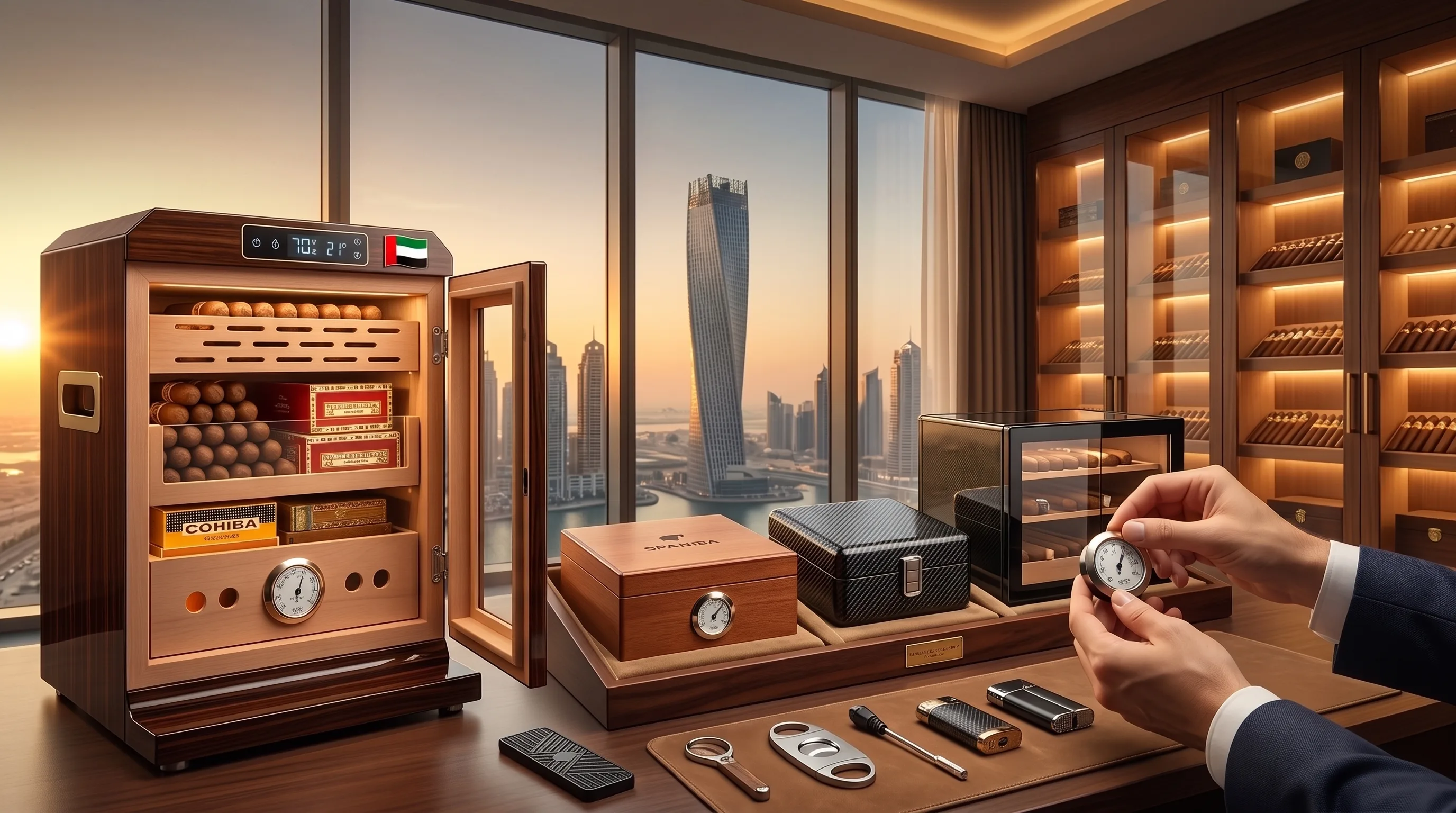
A humidor that works in a Connecticut basement does not necessarily work in a Dubai apartment. The UAE climate creates two specific challenges that humidor manufacturers in cooler regions never had to design for: extended summer temperatures that push interior rooms toward the upper limit of acceptable cigar storage, and aggressive air conditioning that strips ambient humidity out of the air at a rate most humidification systems struggle to compensate for.
The good news is that the UAE’s climate is consistent enough that the right humidor will sit at 65–70% relative humidity and 18–21°C year-round with minimal effort. The bad news is that the wrong humidor will fight you constantly and lose half its battles, leaving you with cigars that split when cut, draw poorly, or develop the dry papery feel that a humidor exists to prevent. This guide separates the equipment that actually handles UAE conditions from the equipment that sells well at the airport.
What’s different about storing cigars in the UAE
Three environmental factors define the storage challenge in this region.
Ambient heat. Inside an air-conditioned UAE home, indoor temperatures sit at 21–24°C — within the acceptable cigar storage range. Outside that bubble, the picture changes fast. A humidor sitting on a balcony, near a sunny window, in a poorly-cooled storage room, or near a kitchen with regular cooking can easily spend long stretches above 25°C, which compromises both flavour preservation and (above 28°C consistently) creates real risk of tobacco beetle hatch from any dormant eggs in the leaf.
AC-dried air. This is the dominant challenge for UAE cigar storage. Modern split-AC units and centralised cooling systems are designed to remove humidity along with heat. Ambient indoor humidity in a UAE apartment with AC running can drop to 30–40% RH or lower — less than half the level required inside a humidor. A humidor in this environment loses moisture through every seal and joint significantly faster than the same humidor would in a cooler, more humid climate.
Temperature swings between AC zones. A humidor moved between an air-conditioned interior (22°C) and an unconditioned area like a balcony or storage closet (35°C+) experiences thermal shock that no humidor handles well over time. The wood expands and contracts; seals lose integrity; humidity drops. The consistent location matters more than the absolute temperature.
Picking the right size
A humidor should be sized for what you actually smoke, not what you might one day collect. The general rules:
• 25–50 count: enough for an occasional smoker with a rotation of 3–4 favourite cigars. Best as a desktop format.
• 75–100 count: the right size for a regular smoker building a real rotation. Most cigars get smoked within 6–12 months, which is the right ageing window for the second half of the post-roll process.
• 150–300 count: cabinet humidor territory. Now you are storing across multiple years, ageing intentional collections, and accommodating boxes purchased at retail.
• 500+ count: a dedicated cabinet, almost always electric or climate-controlled. This is for serious collectors and resellers.
A frequently-broken rule: don’t buy a humidor much larger than you need. An empty humidor is harder to keep stable than a full one, because there is more air space and less tobacco mass to act as a buffer against humidity swings. Buy slightly above your current collection, not five times above it.
What to look for in construction
Spanish cedar interior. Non-negotiable. Spanish cedar (technically Spanish-cedar or Cedrela odorata, a tropical American hardwood, not actual cedar) absorbs and releases moisture at exactly the right rate, repels tobacco beetles, and contributes a faint cedar aroma to the cigars over time. Humidors lined with pine, oak, or generic veneer will not hold humidity properly and will not protect the cigars. If a humidor doesn’t list Spanish cedar in its specification, walk past it.
Seal quality. When you close a quality humidor, you should feel slight resistance from the air being displaced — a faint pop or whoosh. A humidor that closes silently with no resistance has a poor seal, and in a UAE AC environment, that humidor will lose humidity overnight. The test takes two seconds and tells you almost everything about whether the humidor will hold up in the climate.
Hinges and lid weight. Quality humidors use brass quadrant hinges that distribute the weight of the lid evenly and keep the seal even after years of opening. Cheap humidors use stamped metal hinges that loosen over time and develop a slight gap at one corner.
Glass-top humidors. These look beautiful but seal less reliably than solid-top humidors of the same price, and the glass exposes cigars to light, which degrades wrappers over time. In the UAE climate especially, the additional sealing weakness and light exposure makes glass-top humidors a worse choice than they appear.
Humidification: the heart of the system
Three options cover almost all UAE use cases.
Boveda packs. Pre-measured packets of saturated salt solution that maintain a precise RH level (69%, 72%, or 75%) without any need for refilling — you replace them every 3–6 months. Boveda packs are the simplest, most reliable, and most foolproof humidification system, and they handle UAE conditions exceptionally well because they release moisture passively as the surrounding humidity drops. For most UAE users, Boveda is the right answer.
Crystal-gel humidifiers (propylene glycol systems). The traditional small puck or cassette filled with crystal gel that absorbs and releases moisture. These work, but require maintenance — distilled water top-ups every 1–3 weeks in UAE conditions, occasional PG solution recharges, and regular hygrometer calibration. Suitable for users who want a more traditional system and don’t mind the upkeep.
Electronic active humidification. Built-in systems that monitor RH and add moisture automatically. Standard in cabinet humidors above 300-count and increasingly available in desktop sizes. For cabinet collections in the UAE, the active humidification system removes the maintenance question entirely — the cabinet maintains its conditions whether you open it once a week or once a month.
Recommended formats for UAE conditions
Tier 1 — Desktop humidor (AED 800–2,500)
For occasional smokers and gifts. Look for: Spanish cedar lining, solid (not glass) top, brass quadrant hinges, 50–100 count capacity, and use Boveda 72% packs sized for the volume. Reliable brands available in the UAE include Daniel Marshall, Adorini, Visol, and the better Quality Importers (QI) models.
Tier 2 — Mid-size desktop (AED 2,500–6,000)
For regular smokers building a rotation. Look for: hand-finished Spanish cedar interior, double-tongued seal, 100–150 count capacity, and a built-in calibrated digital hygrometer. Brands worth considering: Elie Bleu (the most renowned French humidor maker), Daniel Marshall’s mid-range, Adorini Cedro line, and certain Davidoff humidors.
Tier 3 — Cabinet humidor with active humidification (AED 8,000–20,000)
For collectors. Look for: cabinet-grade build, full Spanish cedar interior including trays and drawers, active electronic humidification (Cigar Oasis is the standard), digital monitoring with remote alerting, 300–500 count capacity, and lockable doors. Recommended: Cigar Oasis-equipped cabinets from brands such as Boveda Cabinet, Adorini Chianti, and the higher-end Daniel Marshall offerings.
Tier 4 — Climate-controlled cigar cooler / electric humidor (AED 5,000–15,000)
A growing category that combines refrigeration-style temperature control with active humidification — essentially a wine fridge designed for cigars. For UAE users worried about summer temperature stability or storing cigars in a less-than-ideal location, these units take the climate question off the table entirely. Look for: dual-zone capability, calibrated digital displays, low-vibration compressors. Recommended: NewAir, Whynter CHC models, and certain Cigar Oasis-equipped electric humidors.
How to set up a humidor properly in Dubai
Whatever humidor you buy, the setup process is the same and matters more than most owners realise.
• Season the humidor before adding cigars. New Spanish cedar is too dry to maintain humidity. Use an 84% RH Boveda pack (or distilled water sponge for traditional setup) for 2–4 weeks before adding cigars, replacing or topping up as needed. Skipping seasoning is the most common UAE setup error.
• Use distilled water only, never tap water. UAE tap water contains minerals and treatment compounds that clog humidification systems and grow bacteria. Distilled water (available at any pharmacy) costs almost nothing and prevents the most common humidor problems.
• Place the humidor away from AC vents, windows, and exterior walls. The ideal spot is an interior wall, away from direct sunlight, in a room with reasonably stable temperature.
• Calibrate the hygrometer every six months using the salt test (a small dish of damp salt in a sealed bag with the hygrometer for 8 hours; correct reading is 75% RH). Most factory hygrometers drift by 2–5 points over time.
• Open the humidor briefly every 1–2 weeks to refresh the air and rotate cigars. UAE conditions reward consistency — don’t leave a humidor closed for months on end, but don’t open it daily either.
FAQ
What’s the best humidor for Dubai’s climate?
For most regular smokers, a Spanish cedar-lined desktop humidor in the 75–150 count range with Boveda 72% RH packs is the best balance of cost, capacity, and reliability in UAE conditions. For collectors, a cabinet humidor with active electronic humidification (Cigar Oasis or equivalent) handles the climate effortlessly across larger collections. Avoid glass-top humidors and any humidor that lacks Spanish cedar lining.
Do I need an electric humidor in Dubai?
Not necessarily. A well-built passive humidor in an air-conditioned interior, with Boveda packs handling humidification, holds 65–70% RH at 22°C reliably across the year. Electric humidors or climate-controlled cigar coolers become worthwhile when you are storing larger collections (300+ cigars), keeping cigars in a less-than-ideal location, or simply want to remove the maintenance question entirely.
What humidity should I set my humidor to in the UAE?
The standard range is 65–70% RH at 18–21°C. In the UAE’s AC-dried indoor environment, 70% RH is often a better target than 65% because the humidor loses moisture faster through seals than in a more humid climate — starting slightly higher gives more margin. Use 72% RH Boveda packs for this reason.
How often do I need to refill or replace humidification?
Boveda packs in UAE conditions typically need replacing every 2–4 months — faster than the 6-month rating that applies to milder climates, because the AC-dried air pulls moisture out of the humidor more aggressively. Traditional crystal-gel humidifiers need distilled water top-ups every 1–3 weeks. Electric humidors with water tanks typically run 4–8 weeks per fill.
Can I store cigars without a humidor in Dubai?
Short-term — a week to a month — yes, in a sealed ziplock bag with a single Boveda 72% pack. This is fine for a small purchase you intend to smoke quickly. For anything longer than a month, an actual humidor is required. UAE indoor air without humidification will dry out cigars within 2–3 weeks to the point where the wrapper splits at the cut.
A closing note
A humidor is the smallest investment that compounds the most over time. The cigars you buy will easily exceed the cost of even a serious humidor within a year, and the difference between cigars stored properly and cigars stored poorly is the difference between an investment and a slow loss. The UAE climate makes the case for getting the storage right early — the cost of replacing a dried-out box of Cohibas significantly exceeds the cost of the Spanish cedar humidor that would have prevented it.